London Bridge, History & Landmarks
The London Bridge, History and Landmarks of Lake Havasu City
Lake Havasu City is young by most standards. Parker Dam created the lake in 1938, Robert P. McCulloch and planner C.V. Wood established the city in 1963, the London Bridge was rebuilt here and dedicated in 1971, and the city incorporated in 1978.
London Bridge and History
History, Landmarks & Local Identity
London Bridge
Visiting the London Bridge in Lake Havasu City
The bridge is free to walk, bike or drive across, any time. Park near English Village and walk the Bridgewater Channel walkway for the best views of the arches and the boat traffic underneath, then cross to the Island side for the beaches.
- The London Bridge storyHow it was bought, numbered, shipped and rebuilt in Lake Havasu City.
- From the Thames to ArizonaThe move, the rebuild and how the Island was created.
- Live London Bridge webcamSee the bridge and the channel right now.
- Drone video over the bridgeA bird's-eye flight over the bridge and the Bridgewater Channel.
- London Bridge DaysThe 50th anniversary celebration and the bridge's yearly events.
- HavasuLew's London Bridge guideHistory, visiting tips and photos on HavasuLew's dedicated London Bridge site.

-
Parker Dam Completed1938Substantially completed in September 1938, forming Lake Havasu
-
City EstablishedSept. 30, 1963By Mohave County resolution creating the Lake Havasu Irrigation and Drainage District
-
London Bridge Purchase$2,460,000Winning bid by Robert P. McCulloch Sr., April 18, 1968
-
Bridge DedicatedOct. 10, 1971After about three years of reconstruction
-
City Incorporated1978The same year the last parcel of McCulloch land sold
-
Lighthouses28Working replica lighthouses listed by the Lake Havasu Lighthouse Club
Where these numbers come from
-
U.S. Bureau of ReclamationParker Dam CompletedThe federal agency that runs Parker Dam and manages water levels on the lower Colorado River.Open usbr.gov
-
Go Lake HavasuCity EstablishedThe city's official tourism bureau: events, the visitor center, London Bridge information, lodging and maps.Open golakehavasu.com
-
Go Lake HavasuLondon Bridge PurchaseThe city's official tourism bureau: events, the visitor center, London Bridge information, lodging and maps.Open golakehavasu.com
-
Lake Havasu Lighthouse ClubLighthousesThe volunteer club that builds and maintains the replica lighthouses.Open lh-lighthouseclub.org
| Year | What happened |
|---|---|
| 1938 | Parker Dam is completed in September, and Lake Havasu fills in behind it. |
| 1941 | Havasu National Wildlife Refuge is established along the river north of today's city. |
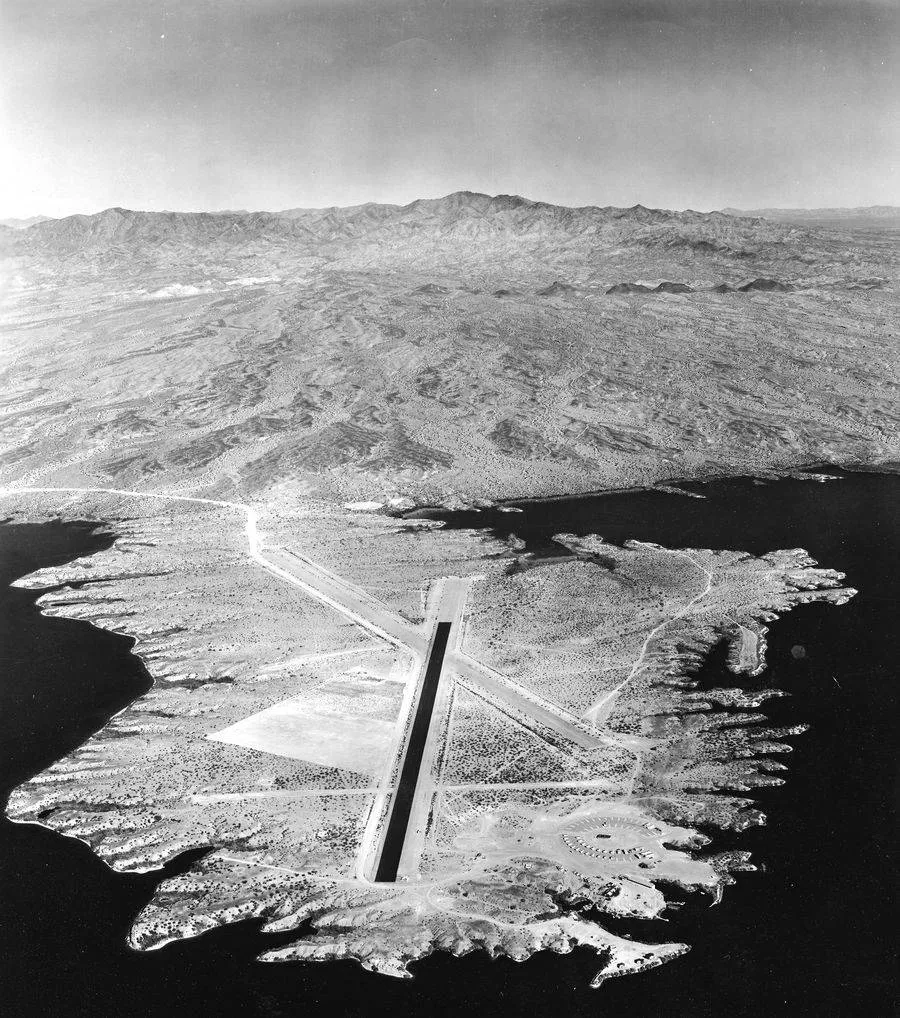
| 1942–1946 | Site Six on Pittsburg Point, today's Island, serves as a World War II emergency landing field and rest camp. |
| 1963 | Lake Havasu City is established on September 30, with Robert P. McCulloch Sr. and C.V. Wood leading the development. |
| 1968 | McCulloch buys the London Bridge on April 18 for $2,460,000, and the first stone is set in Lake Havasu City on September 23. |
| 1968–1971 | The bridge is rebuilt on dry land, then the Bridgewater Channel is dug beneath it, turning Pittsburg Point into the Island. |
| 1971 | The London Bridge is dedicated in Lake Havasu City on October 10. |
| 1978 | Lake Havasu City incorporates as a city. |
| Early 2000s | The Lake Havasu Lighthouse Club starts building working replica lighthouses around the lake. |
| 2021 | Lake Havasu City celebrates 50 years of the London Bridge with London Bridge Days. |
Local tip: The London Bridge is a working city street, not a museum piece: you can walk, bike or drive across it at no charge.
Quick answer
The London Bridge in Lake Havasu City is the 1831 bridge that once crossed the River Thames in London. When London needed a wider, sturdier replacement, Lake Havasu City founder Robert P. McCulloch Sr. won the bid on April 18, 1968, for $2,460,000. Its granite facing was shipped to Arizona, rebuilt over a modern concrete-and-steel core, and dedicated on October 10, 1971.
Local context
By the 1960s, the bridge was slowly sinking into the Thames and was not suited to modern traffic. Go Lake Havasu's anniversary fact sheet says the City of London had put it up for sale by 1962, and London built a wider replacement.
McCulloch was building a brand-new desert city and needed a reason for people to come see it. The bridge became that reason, and it is still the city's signature landmark.
A popular story says the buyers thought they were getting Tower Bridge. History.com notes that the rumor has been discredited.
In Arizona, the bridge was rebuilt on dry land first. Crews then dug a channel beneath it and let it fill with water, creating the Bridgewater Channel and the Island.
Why it matters
The bridge is the reason many people first hear of Lake Havasu City, and the Channel and Island it created are still the busiest visitor area in town.
HavasuLew IQ Note
For deeper history, photos and visiting tips, HavasuLew's dedicated London Bridge site goes well beyond this summary.
Quick answer
The London Bridge was taken apart in London, and each exterior granite block was numbered by position, shipped through the Panama Canal to Long Beach, California, and trucked to Lake Havasu City. Reconstruction began on September 23, 1968, and took about three years, ending with the dedication on October 10, 1971. Go Lake Havasu puts the cost of shipping, assembly and dredging at about $7 million.
Local context
The Arizona bridge is not a solid stone bridge like the original. It was rebuilt with a hollow, steel-reinforced concrete core faced with the original granite, which cut its weight from about 130,000 tons to about 30,000 tons so it could carry modern traffic.
Workers built it on dry land. Once the bridge stood, they dredged a channel underneath, through the strip of land that connected Pittsburg Point to the mainland, and flooded it. That is how the Bridgewater Channel and the Island were born.
The bridge by the numbers
- Granite Blocks: 10,276 numbered exterior blocks.
- Length: 930 feet, with five arched spans.
- Width: 56 feet, including a 35-foot roadway.
- Rebuild Time: About three years, from 1968 to 1971.
- Move and Rebuild Cost: About $7 million for shipping, assembly and dredging.
Why it matters
The engineering explains why a nearly 200-year-old bridge can carry everyday traffic today, and why the Island exists at all.
HavasuLew IQ Note
Walk the bridge early in the morning, when the light is soft and the Channel is quiet, and you can take in the granite detail without the crowds.
Quick answer
Yes. You can walk, bike or drive across the London Bridge in Lake Havasu City, and there is no charge. The bridge carries McCulloch Boulevard, a public street maintained by Lake Havasu City, and it is the road link between the mainland and the Island for pedestrians, cyclists and drivers.
Local context
English Village, right next to the bridge, is home to the Go Lake Havasu Visitor Center and makes an easy starting point. Go Lake Havasu notes free parking near the English Village ferry terminal.
London Bridge Beach, a city park along the Bridgewater Channel just over the bridge, has walking paths, playgrounds, a buoyed swim area and picnic ramadas, so it pairs well with a bridge walk.
Expect heavy foot, car and boat traffic around the bridge on holiday weekends, during spring break and during big events. Early mornings and weekday evenings are calmer.
The bridge is 930 feet long, so an easy round-trip walk takes only about 10 minutes, and the passenger ferry to the California shore leaves from near English Village. If you cannot visit in person, HavasuLew's London Bridge webcam page lets you watch the bridge and Channel live.
Why it matters
Because the bridge is a working street, it is part of daily life for anyone living or staying on the Island, not just a photo stop.
HavasuLew IQ Note
Cross on foot near sunset, then walk down toward the Channel. It is the simplest way to see why the Island area draws so many people.
Quick answer
The London Bridge in Lake Havasu City dates to 1831, when it opened over the River Thames, so its granite is about 195 years old as of 2026. The Arizona version was rebuilt between 1968 and 1971, with the original granite facing set over a modern concrete-and-steel structure, so the bridge has stood in Lake Havasu City for 55 years.
Local context
Construction in London began in 1824, the first stone was laid in 1825, and King William IV opened the bridge on August 1, 1831. It was designed by Scottish engineer John Rennie. By 1924, Go Lake Havasu notes, the bridge's east side had sunk three to four inches below its west side, an early sign of the problems that led to its sale.
It is not the medieval London Bridge. A stone bridge built between 1176 and 1209 stood on the site for centuries before Rennie's bridge replaced it, and earlier timber bridges came before that.
The stones carry their own history. Go Lake Havasu's anniversary fact sheet notes graffiti carved by two American soldiers, dated August 1942, from the bridge's years in London.
Why it matters
Knowing which bridge you are standing on, the 1831 granite in a 1971 rebuild, makes the visit far more interesting and helps when you are explaining it to guests.
HavasuLew IQ Note
Pair a bridge walk with a stop at the Go Lake Havasu Visitor Center in English Village, right next to the bridge.
Quick answer
Yes. The London Bridge in Lake Havasu City is the same granite bridge that crossed the River Thames from 1831 until it was sold in 1968. Robert P. McCulloch Sr. bought it, had the exterior granite blocks numbered and shipped to Arizona, and rebuilt them over a new concrete and steel structure. It is not Tower Bridge, the towered drawbridge many people picture when they hear "London Bridge."
Local context
The crossing itself is ancient. The Institution of Civil Engineers notes that the Romans may have built the first bridge there, timber bridges followed, and a stone bridge begun in 1176 took about 30 years to build and then stood for centuries.
Rennie's bridge, the one now in Arizona, replaced that medieval structure in 1831. By the 1960s it was sinking slowly and was not built for modern traffic, which is why London sold it and built today's bridge.
Today's London Bridge was built by the firm John Mowlem & Co. and carries traffic across the Thames in the City of London. Tower Bridge, the twin-towered drawbridge many people picture when they hear London Bridge, is a separate bridge farther down the river. It was never part of this story, despite the old rumor.
Why it matters
Visitors on the bridge often wonder about this, and knowing the timeline helps you set the record straight.
HavasuLew IQ Note
If you have crossed London Bridge in London, you have seen the replacement. Havasu has the original 1831 granite.
Quick answer
Lake Havasu City was founded by industrialist Robert P. McCulloch Sr., working with developer C.V. Wood, who had earlier designed Disneyland. The city was established on September 30, 1963, through a Mohave County Board of Supervisors resolution creating the Lake Havasu Irrigation and Drainage District, and it incorporated as a city in 1978.
Local context
McCulloch, owner of McCulloch Motors, flew over Lake Havasu in 1963 looking for a place to test outboard engines and saw a city site instead. He went on to use Site Six, a former World War II landing field and rest camp on Pittsburg Point, as a test center for his outboard motors.
Over the next four years, 16,520 acres were acquired and prepared. From 1964 to 1978, the development ran 2,702 flights that brought about 137,000 prospective land buyers to see the city, and the London Bridge purchase in 1968 gave visitors a landmark to see.
By the time of the London Bridge purchase, McCulloch was chairman of McCulloch Oil Corporation. He died in 1977. The last parcel of land sold in 1978, and Lake Havasu City incorporated later that year.
Why it matters
The city's planned, sold-as-lots origin still shapes it today: much of the land was sold decades ago and built on at different times.
HavasuLew IQ Note
That history is why a 1970s home can sit next to brand-new construction. Lots sold long ago have been built on in every decade since.
Quick answer
Havasu comes from the Mojave language, also spelled Mohave, and is generally translated as “blue,” with some sources rendering it as “blue water.” The name fits Lake Havasu, the reservoir that formed behind Parker Dam in 1938 and is known for its blue color, and Lake Havasu City took its name from the lake.
Local context
Reference sources say the lake was named in 1939, shortly after Parker Dam was completed. Go Lake Havasu notes the reservoir reached its full capacity of about 211 billion gallons between 1940 and 1942. The word shows up all over the area today, from the Havasu National Wildlife Refuge, established in 1941, to communities and subdivisions such as Havasu Riviera and Havasu Heights.
Locals use “Havasu” as shorthand for the lake, the city or the whole area, depending on the conversation. You will also hear Lake Havasu City called “Arizona's West Coast,” a nickname Go Lake Havasu uses.
Why the water looks so blue is its own question, and the Lake section of this page covers it.
Why it matters
The name is part of the local identity you will see on everything from street signs to subdivision names, and it is a fun piece of trivia for guests.
HavasuLew IQ Note
When someone local says “Havasu,” they may mean the city, the lake or the whole area. Ask which one when directions matter.
Your next step
Quick answer
Before Parker Dam, the Lake Havasu area was a stretch of the free-flowing lower Colorado River running through desert valleys and canyons, home to Native peoples including the Mohave and Chemehuevi. The U.S. Bureau of Reclamation began excavation for Parker Dam in October 1934 and substantially completed it in September 1938, and the rising water created Lake Havasu.
Local context
The new reservoir changed the land around it. Reporting by High Country News and ProPublica describes about 7,000 acres of Chemehuevi land on the California side, including homes and grazing land, going under water as the lake rose.
Parker Dam is often called the deepest dam in the world because about 73% of its 320-foot structural height sits below the original riverbed. The lake it formed backs up about 45 miles and now feeds both the Colorado River Aqueduct to Southern California and the Central Arizona Project.
Upstream, Topock Gorge, protected within the Havasu National Wildlife Refuge since 1941, still shows what a natural stretch of the lower Colorado looks like. During World War II, Site Six on Pittsburg Point served as an emergency landing field and rest camp for Kingman Army Air Field.
Why it matters
The dam is the reason there is a lake and a city here at all, and Reclamation still manages the lake within a narrow operating range today.
HavasuLew IQ Note
Drive down to Parker Dam sometime. Seeing how modest the dam looks for the amount of water it holds makes the deepest-dam fact click.
Your next step
Quick answer
Lake Havasu's lighthouses are working navigational aids built to make night boating and fishing safer. The nonprofit Lake Havasu Lighthouse Club builds and maintains scaled-down replicas of well-known lighthouses from the East Coast, West Coast and Great Lakes, and its list shows 28 around the lake. Go Lake Havasu says that gives Lake Havasu City more lighthouses than any other U.S. city.
Local context
The layout follows a pattern. West Coast replicas sit on the western shore and show green lights, East Coast replicas sit on the eastern shore and show red, and Great Lakes replicas ring the Island. A flashing amber light marks an emergency safe harbor.
The list includes replicas of Cape Hatteras, Split Rock, Portland Head, Pigeon Point, Barnegat, Sandy Hook and Angels Gate, among others. Many were funded by sponsors such as families, businesses and groups, and the club relies on support to keep them lit.
Some lighthouses can be reached on a short hike, while others are boat-access only. Narrated lighthouse boat tours run seasonally, and Go Lake Havasu lists current options.
Why it matters
For boaters, the lights are practical navigation tools on a big lake at night. For everyone else, they are one of the most distinctive things about Havasu.
HavasuLew IQ Note
If you boat after dark, learn the color pattern before you need it. Green to the west, red to the east is an easy way to keep your bearings.
Your next step
Quick answer
Partly. The land was a natural peninsula called Pittsburg Point (sometimes spelled Pittsburgh), but it became an island when crews dug a channel across it while rebuilding the London Bridge between 1969 and 1971. The bridge was rebuilt on dry land first, then the channel was dredged beneath it and flooded, creating the Bridgewater Channel and the Island in Lake Havasu City.
Local context
Arizona State Parks' history of the area describes the change plainly: rebuilding the bridge and digging the channel changed the shoreline, and Pittsburg Point became an island. History.com describes the cut as a roughly mile-long channel through an isthmus.
Pittsburg Point had a history before the bridge. In 1965, McCulloch Properties held a state park concession covering about 1,200 acres, mostly on the point, and a 1986 land exchange later transferred the point and its concession operations to the State Land Department. During World War II, Site Six on the point served as an emergency landing field and rest camp.
Today the London Bridge is the Island's road link to the mainland, and the Island is a mix of resorts, homes and recreation areas.
Why it matters
The Island's man-made channel is why so much of Havasu's boating, dining and event activity concentrates around the bridge.
HavasuLew IQ Note
The Island has its own rhythm, busy on event weekends and quieter midweek, so visit both ways if you are considering a home there.
Quick answer
Lake Havasu City is known for the London Bridge, rebuilt here and dedicated in 1971, and for Lake Havasu itself, a reservoir about 45 miles long with more than 400 miles of shoreline that draws boaters, anglers and personal watercraft racers. It is also known for spring break crowds, 28 working replica lighthouses, the “Arizona's West Coast” nickname and a full calendar of winter and water events.
Local context
On the water, Havasu hosts the IJSBA World Finals, the world championship of personal watercraft racing, each October. Go Lake Havasu also cites the lake as one of America's top 100 bass fishing lakes and a known striped bass fishery.
The city's origin story is part of its identity, too: a planned community founded by Robert P. McCulloch in 1963, promoted with thousands of flights that brought prospective buyers to town, and anchored by a 19th-century bridge bought from London.
Mild winters bring seasonal residents and a busy run of events, while summer belongs to the lake.
What Havasu is known for
- The London Bridge: The 1831 Thames bridge, rebuilt over the Bridgewater Channel.
- Boating: A big, blue lake with coves, beaches and the Channel.
- Personal Watercraft Racing: Home of the IJSBA World Finals each October.
- Fishing: Bass and striped bass draw anglers to the lake.
- Lighthouses: 28 working replicas around the lake.
Why it matters
Knowing what draws people here explains the city's busiest seasons, its event calendar and why certain homes, like those with boat or RV storage, are in demand.
HavasuLew IQ Note
Visit on a regular weekday as well as a big event weekend to see both sides of the city before you decide where you want to be.
Keep going
London Bridge Resources
The deeper HavasuLew pages first, then the official sources for anything that changes.
More HavasuLew guides for this topic are on the way. Until then, the chat below knows every page on the site.
Ask
Ask HavasuLew IQ About London Bridge
Anything this guide did not cover: the chat knows this page, the rest of HavasuLew IQ, the live searches and current conditions.
Local Lake Havasu City Answers
Ask HavasuLew IQ
Ask anything about Lake Havasu City: boating, neighborhoods, homes, weather, costs or moving here. You get a clear answer in plain words, plus a useful next step.
Or tap a popular question:
Your conversation is saved on this device.
Chats are saved anonymously for up to 30 days to improve answers. Please don’t share personal information, and double-check details that can change.
Ask HavasuLew
When You Want a Person, Not a Page
HavasuLew IQ™ gives you the local context. HavasuLew answers the question the page did not, or builds the search around how you plan to use the home.
- A clear answer in plain words
- A search built around how you will use the home
- The right official source when a rule or fee has changed
HavasuLew IQ™ is written and kept current by HavasuLew, Lake Havasu City, Arizona. Equal Housing Opportunity.
Updated . Rules, fees, schedules and property details can change, so confirm anything time-sensitive before you rely on it.