Updated July 30, 2026 · Lake Havasu City, Arizona
Lake Havasu City Short-Term Rental Reclassification
What Lake Havasu City Property Owners Need to Know
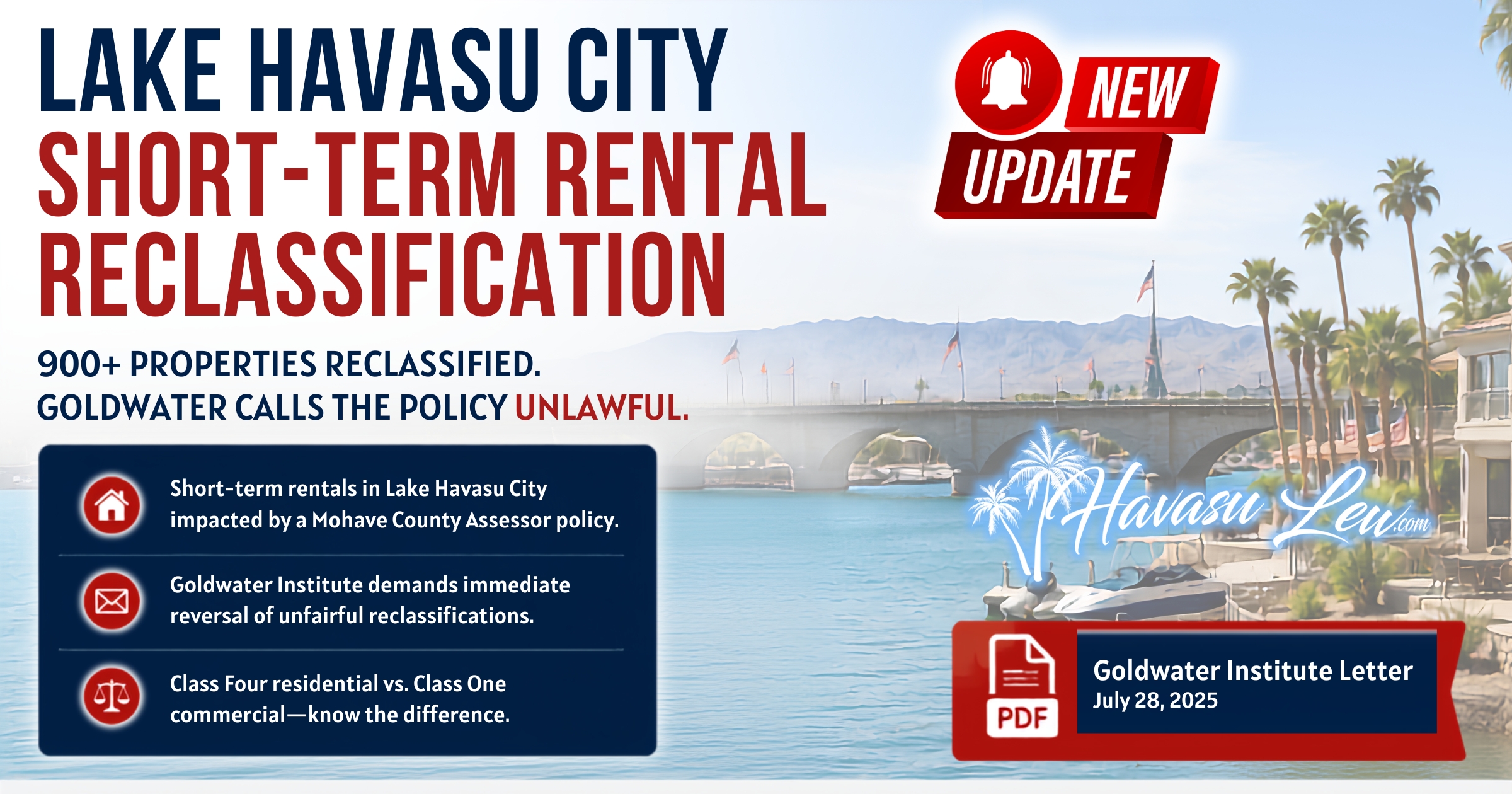
Lake Havasu City short-term rental owners are being directly affected by a new Mohave County Assessor policy that reclassifies certain residential vacation rentals as Class One commercial property. More than 900 properties have reportedly already been reclassified across Mohave County, including properties in the Lake Havasu City market.
This is an active legal and property-tax dispute affecting Lake Havasu City short-term rental owners. Goldwater has formally challenged the policy, but the materials reviewed for this page do not show a court ruling that has resolved the issue or a published County rescission as of July 30, 2026.
The issue in plain English
Are Lake Havasu City short-term rentals being treated as commercial property?
Yes. The Mohave County Assessor is applying the policy countywide, and Lake Havasu City contains the majority of Mohave County's reported short-term rentals. The Assessor says homes primarily operated as year-round rentals for stays of fewer than 30 days should be classified like hotels and motels. Goldwater argues Arizona law already places ordinary residential rentals—including homes rented to lodgers—in residential Class Four, and that the Assessor cannot create a blanket commercial rule on her own.[1][3][4][5]
Local REALTOR® association update
AAR provided the Goldwater letter to the Lake Havasu Association of REALTORS®
The Arizona Association of REALTORS® (AAR) reports that it and its lobbyists have been in contact with Airbnb and the Goldwater Institute regarding the Mohave County short-term rental reclassification. AAR also provided the Goldwater Institute's July 28, 2026, letter to the Lake Havasu Association of REALTORS® (LHAR) for local awareness and distribution.[19]
Why that matters locally
This is not a remote countywide tax issue with little connection to Lake Havasu. The majority of Mohave County's reported short-term rentals are located in Lake Havasu City, so local owners, buyers, sellers and real estate professionals are likely to see the greatest practical impact if the policy remains in place.
The Assessor's policy
What changed for Lake Havasu City short-term rentals
Mohave County Assessor Jeanne Kentch announced that the County is classifying residential properties as commercial when it determines they are primarily available as short-term rentals for most of the year. Because the majority of the County's reported short-term rental inventory is in Lake Havasu City, the local market is at the center of the policy's practical impact. The stated target is non-owner-occupied homes rented for periods shorter than 30 days—not an owner-occupied primary residence or a home rented only during limited seasons.[1]
- The County compares full-time short-term rentals to hotels and motels. Its position is that both provide temporary lodging and should receive the same commercial tax treatment.
- The Assessor says classification is based on current use. The office cites Airbnb and Vrbo listings, city permit records, advertisements, owner affidavits and other available information when deciding a property's primary use.
- The policy is categorical in practical effect. According to the County's announcement, the office intends to keep reclassifying qualifying full-time short-term rentals until all have been addressed.
- The change affects assessed valuation—not just a label. Moving a parcel from Class Four to Class One increases the percentage of limited property value used to calculate assessed value.
Why Goldwater is pushing back
Why Lake Havasu short-term rental owners are calling this Assessor overreach
The County is making a policy argument about fairness between vacation rentals and hotels. Goldwater is making a statutory-authority argument: Arizona property classes are set by the Legislature, and an assessor cannot bypass a class that already covers the property. That is the core of the overreach claim—not that the County lacks concerns about full-time rentals, but that an elected assessor is trying to impose a statewide tax-policy result that lawmakers did not enact.
The County's position
A full-time short-term rental generates income and provides temporary lodging. The Assessor says that makes its current use commercially similar to a motel or hotel, even when the building remains a conventional house.[1]
Goldwater's response
Class One is a residual category. Its commercial-property provision applies only when the property is not specifically included in another class. Class Four expressly covers residential property, residential property that is leased or rented and residential property leased or rented to lodgers.[3][4][5]
- Residential use does not disappear because the owner earns income. Long-term rentals also produce income, yet Arizona law expressly places residential rental property in Class Four.
- The length of a guest's stay is not an assessment-ratio rule in the current classification statutes. Arizona law does not presently say that a house becomes Class One merely because stays are shorter than 30 days or the calendar is open year-round.
- Arizona's vacation-rental statutes distinguish residential lodging from nonresidential activity. They separately identify event centers, restaurants, retail operations and banquet uses as nonresidential uses.[8][9]
- A normal house is not automatically a hotel. A specific property could develop genuinely commercial characteristics, but Goldwater says that does not justify a blanket rule for every full-time residential short-term rental.
Related Arizona case law: Qasimyar v. Maricopa County was not a short-term rental case and does not decide this dispute. It is relevant because the court treated property classification as a statutory, use-based question and recognized taxpayer-favorable construction principles when tax statutes remain ambiguous.[18]
Important distinction: Goldwater has called the policy unlawful, but that is a legal position—not a final court judgment. The accurate public wording is that the policy is being challenged as unlawful or that Goldwater says it violates Arizona law.
The legislative problem for the County
Arizona lawmakers considered explicit STR reclassification bills—and did not enact them
In 2025, HB 2316 proposed adding short-term rental property to Class One. In 2026, HB 2362 proposed a more specific threshold for homes rented for fewer than 30 days for more than 180 days per year. Neither proposal became law.[2][11][12][13]
A failed bill does not automatically prove that the Assessor's interpretation is illegal. It does, however, raise an obvious question: if existing law already gave assessors clear authority to apply this rule, why was new statutory language proposed to create substantially the same result?
The Arizona Legislature did directly address vacation rentals in 2016 through SB 1350, including amendments to the residential property-classification statutes.[10] Goldwater's argument is that those provisions preserved residential classification for ordinary residential short-term rentals rather than handing assessors an open-ended power to convert them to Class One.
Property-tax effect
What the change could mean for Lake Havasu City STR taxes
Arizona does not apply the tax rate directly to the property's market price. The property's limited property value is multiplied by the applicable assessment ratio to produce assessed value. Taxing jurisdictions then apply their rates to that assessed value.
| Classification | Assessment ratio | Example using $400,000 LPV | Difference from Class Four |
|---|---|---|---|
| Class Four residential | 10% | $40,000 assessed value | Baseline |
| Class One through Dec. 31, 2026 | 15.5% | $62,000 assessed value | 55% higher assessed value |
| Class One beginning after Dec. 31, 2026 | 15% | $60,000 assessed value | 50% higher assessed value |
Class Four is assessed at 10%. The current Class One statute sets the ratio at 15.5% through December 31, 2026, then 15% beginning after that date.[6][7]
There is a public-number discrepancy worth noting. The Assessor's announcement and Goldwater's letter refer to a 15% Class One ratio. The current text of A.R.S. § 42-15001 lists 15.5% through the end of 2026 and 15% after that. Owners should rely on the classification and ratio shown on their actual notice, current Arizona law and qualified tax advice—not a simplified public statement.
The percentage increase in assessed value does not guarantee that every final tax bill rises by the exact same percentage. Limited property value, district tax rates, exemptions, timing and other parcel-specific factors still matter. A higher assessed value can also create an escrow shortage or a higher monthly mortgage payment when a loan servicer recalculates reserves.
Practical response
What an affected property owner should do now
Do not assume the broader political or legal fight will protect an individual appeal deadline. A countywide reversal and a parcel-level appeal are separate tracks.
- Save the notice, envelope and mailing date. Arizona property-tax deadlines can run from the mailing date of the applicable notice. Do not wait for the eventual tax bill to start reviewing the issue.
- Verify the parcel record. Check the Mohave County Assessor record for the current legal class, use code, limited property value and any classification-change information.[14]
- Read the exact appeal instructions on the notice. The correct procedure can depend on the type and timing of the notice. Confirm the deadline directly with the Assessor and a qualified Arizona property-tax professional.
- Gather evidence of the property's actual use. Preserve booking calendars, owner-use dates, leases, advertisements, permits, occupancy records and any facts showing how the dwelling is actually used.
- Get legal or tax advice early. This dispute involves statutory interpretation, administrative deadlines and potential tax refunds. A real estate agent cannot give the owner the legal opinion or tax representation this situation may require.
- Keep separate compliance issues separate. A property-tax classification dispute does not erase Lake Havasu City licensing, transaction privilege tax, rental registration, insurance, zoning or Homeowners Association restrictions.[16][17]
Lake Havasu real estate impact
What buyers and sellers should take from this
For buyers
- Do not underwrite a purchase from the seller's old tax bill alone. Confirm the current class and ask whether any reclassification notice, appeal or pending dispute exists.
- Verify each layer independently. Property-tax class, city vacation-rental licensing, transaction privilege tax, insurance, zoning and HOA/PUD restrictions are separate issues.
- A permit is not a guarantee of future tax treatment. A city license allows regulated use; it does not lock in a county assessment classification.
- Do not buy strictly on projected rental income. Rules, expenses, classifications and operating conditions can change.
For sellers
- Disclose what you actually know. A classification notice, pending appeal or material tax change should be handled with the appropriate broker, legal and tax guidance.
- Do not represent residential tax treatment as guaranteed. The issue is unsettled and parcel-specific facts may matter.
- Separate actual history from projections. Provide verifiable permits, expenses and rental records without promising future performance.
- Expect buyers to ask harder questions. A well-organized file can reduce confusion during due diligence.
How the dispute developed
Lake Havasu City short-term rental reclassification timeline
Arizona enacts SB 1350
The Legislature creates a statewide vacation-rental framework and amends the Class Three and Class Four residential classification statutes.[10]
HB 2316 proposes explicit Class One treatment
The proposal would add certain short-term rentals to Class One. It does not become law.[11][13]
HB 2362 proposes a 180-day threshold
The bill would classify a home as Class One when rented for fewer than 30 days for more than 180 days in a calendar year. It also does not become law.[12][13]
Mohave County publicly announces its policy
The Assessor says more than 900 properties have already been reclassified and that the office will continue reviewing full-time short-term rentals.[1]
Goldwater demands an immediate suspension
Goldwater sends a formal letter to Assessor Jeanne Kentch calling the policy unlawful and demanding restoration of affected non-owner-occupied residential short-term rentals to Class Four.[3]
AAR provides the Goldwater letter to LHAR
The Arizona Association of REALTORS® (AAR) reports that it and its lobbyists have been in contact with Airbnb and the Goldwater Institute. AAR provided the July 28 Goldwater letter to the Lake Havasu Association of REALTORS® (LHAR) for local awareness and distribution. Owners still need to protect any parcel-specific appeal rights while the larger challenge develops.[19]
Common questions
Lake Havasu City short-term rental reclassification FAQs
What are AAR and LHAR doing about the Lake Havasu short-term rental reclassification?
The Arizona Association of REALTORS® reports that it and its lobbyists have been in contact with Airbnb and the Goldwater Institute. AAR provided the Goldwater Institute's July 28, 2026, letter to the Lake Havasu Association of REALTORS® for local awareness and distribution. That association involvement does not replace an individual owner's need to protect parcel-specific appeal rights and deadlines.
Is Mohave County reclassifying every short-term rental?
No. The Assessor says the policy targets non-owner-occupied properties primarily available as short-term rentals for most of the year, with stays shorter than 30 days. The announcement says owner-occupied primary residences and limited seasonal rentals are not the intended target. The actual parcel record and notice still control for a specific property.
Has a court ruled that the Mohave County policy is unlawful?
Not in the materials reviewed for this page as of July 30, 2026. The Goldwater Institute has taken the formal position that the policy violates Arizona law and has threatened judicial remedies if the County does not reverse course. That is a serious legal challenge, but it is not yet the same as a final court ruling.
What is the difference between Class One and Class Four property?
Class Four includes several forms of residential property, including residential property that is leased or rented and residential property rented to lodgers. Class One includes commercial and industrial property not specifically included in another class. The dispute is whether a full-time short-term rental remains within the residential provisions or crosses into commercial use.
How much can the assessment ratio change?
Class Four uses a 10% assessment ratio. Class One uses 15.5% through December 31, 2026 and 15% after that under the current statute. Using the same limited property value, that produces assessed value 55% higher in 2026 and 50% higher after 2026. The final tax bill depends on the parcel's value and applicable tax rates.
Does paying lodging tax make the real estate commercial property?
Not automatically. Transaction privilege tax applies to the business activity and rental income. Property-tax classification concerns the legal class assigned to the underlying real estate. Goldwater's position is that business-tax treatment does not erase the Legislature's residential property classifications.
Are ordinary short-term rentals legally the same as hotels?
That is one of the disputed points. The County emphasizes temporary lodging and year-round commercial operation. Goldwater emphasizes the physical use of an ordinary house and the statutory distinction between residential dwellings and genuinely nonresidential operations such as restaurants, retail uses, banquet facilities and event centers.
Can an owner appeal a reclassification?
Property owners generally have administrative and judicial avenues to challenge valuation or classification decisions, but the correct procedure and deadline depend on the notice. Owners should read the notice immediately, confirm the applicable deadline with the Mohave County Assessor and obtain qualified Arizona property-tax advice.
Does this change Lake Havasu City's vacation-rental permit rules?
No. County property classification and Lake Havasu City's vacation-rental regulatory requirements are separate. Owners still need to comply with current city licensing, contact, insurance, advertising and other requirements, along with applicable transaction privilege tax and private HOA or PUD restrictions.
What should a buyer verify before purchasing a possible vacation rental?
Verify the current property class, tax history, city licensing status, zoning, rental registration, insurance availability, HOA/PUD restrictions, prior notices and any pending appeal. Buyers should also separate verified historical revenue and expenses from future projections and avoid assuming that current rules or classifications are guaranteed to remain unchanged.
Off-site citations
Primary laws, public statements and reporting used for this page
Statutes and official government pages are used for the controlling legal text and public procedures. News reporting is used for statements, chronology and positions attributed to the parties. The Goldwater letter is the source for Goldwater's demands and legal position.
- Mohave County Assessor policy announcement: “County Corner: New policy regarding Short-Term Rentals”
- Arizona Capitol Times: Mohave County reclassifies short-term rentals to commercial, drawing opposition
- Goldwater Institute letter to Mohave County Assessor Jeanne Kentch, dated July 28, 2026
- A.R.S. § 42-12001 — Class One property
- A.R.S. § 42-12004 — Class Four property
- A.R.S. § 42-15001 — Assessed valuation of Class One property
- A.R.S. § 42-15004 — Assessed valuation of Class Four property
- A.R.S. § 9-500.39 — City and town vacation-rental regulation
- A.R.S. § 11-269.17 — County vacation-rental regulation
- Arizona SB 1350 (2016) — online lodging and vacation-rental legislation
- Arizona HB 2316 (2025) — proposed short-term rental property classification changes
- Arizona HB 2362 (2026) — proposed 180-day short-term rental classification threshold
- Arizona REALTORS® 2026 legislative updates — short-term rental tax-classification bills
- Mohave County Assessor property search
- Mohave County property-tax and appeal information
- Lake Havasu City vacation-rental requirements
- Arizona Department of Revenue short-term lodging tax information
- Qasimyar v. Maricopa County — Arizona property-classification decision
- Arizona Association of REALTORS® email accompanying the Goldwater Institute letter and provided to the Lake Havasu Association of REALTORS® in July 2026. This association communication is not a public web source.
Buying or selling a Lake Havasu property?
Review the property use before the deal gets expensive
Short-term rental potential is only one layer. The tax class, city rules, HOA/PUD restrictions, insurance, parking, garage fit and resale risk all need to be checked separately. I can help organize the real estate side of that due diligence and identify the questions that need to go to the County, City, title company, attorney or tax professional.